

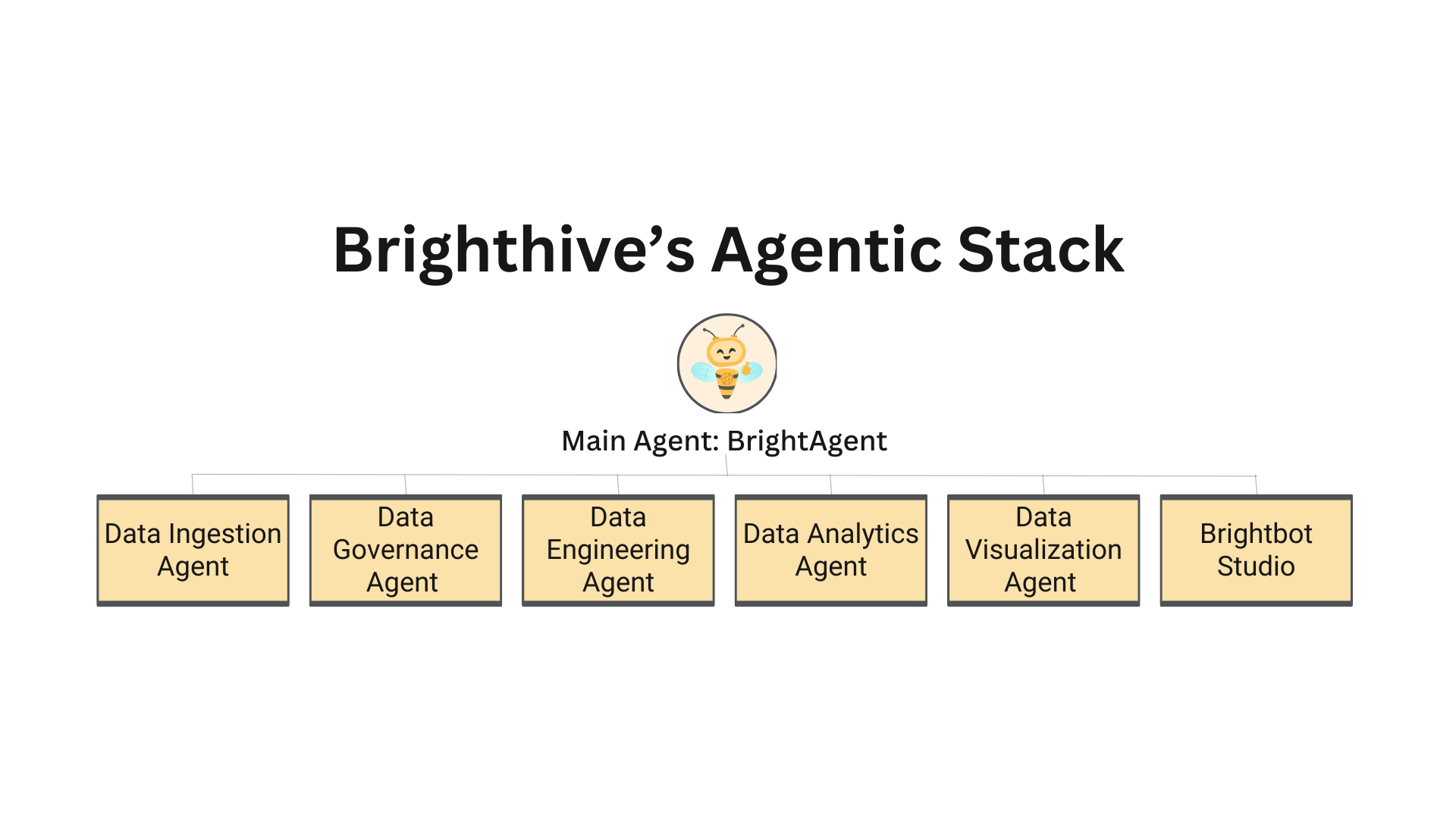
One Interface, Many Agents
You interact with one AI assistant. Behind the scenes, a BrightAgent orchestrates specialized agents to handle your request — analyzing intent, routing to the right experts, coordinating multi-step workflows, and synthesizing results into a clear response. The BrightAgent doesn’t just pick one agent per query. A question like “show me a chart of sales by region” triggers three agents in coordination: the Retrieval Agent finds the right data, the Analyst Agent queries and aggregates it, and the Visualization Agent produces the chart. You see one seamless answer.Specialized Agents
Retrieval
Finds and fetches data from your warehouse, data lake, and metadata catalog so you don’t have to know where things live.
Analysis
Queries your data, runs statistical analysis, and generates Jupyter notebooks with insights — all from a natural language question.
Engineering
Generates dbt models for data transformation and submits them as GitHub PRs for your review before deployment.
Visualization
Creates interactive charts and visualizations from your data — just describe what you want to see.
Governance
Tracks data quality, manages metadata, and maintains lineage across your data estate via Neo4j.
Quality
Validates data completeness, accuracy, and consistency — surfacing issues before they reach your reports.
Metadata
Uses OpenMetadata to generate descriptions, understand schemas, enrich your catalog with tags and documentation, and track lineage.
Slack (Beta)
Interact with BrightAgent directly from Slack — query data, manage Jira tickets, search Notion, and more.
How Agents Collaborate
BrightAgent isn’t a collection of isolated tools — agents coordinate to handle complex, multi-step tasks that span the entire data lifecycle.Multi-Agent Workflow Example
Coordination Patterns
Parallel Execution
Multiple agents work simultaneously when tasks are independent — data retrieval and visualization setup can run in parallel to reduce response time.
Sequential Chaining
Some workflows require step-by-step execution: Retrieval first finds data, then Analysis queries it, then Visualization charts the results.
Context Sharing
Agents share relevant context and intermediate results through shared state — the Analyst Agent knows exactly which data the Retrieval Agent found.
What You Can Ask
BrightAgent handles the full range of data operations through natural language:Human-in-the-Loop
BrightAgent is designed so that AI assists your workflow without making irreversible changes autonomously:- dbt Models — Generated transformation code is submitted as a GitHub PR. Your team reviews before merging.
- Code Generation — Jupyter notebooks and analysis scripts are presented for review before execution.
- Governance Actions — Changes to data policies and access controls require explicit user confirmation.
Continuous Quality
Every agent interaction is evaluated in real-time for relevance, correctness, and goal accuracy. Quality metrics are tracked across all agents and fed back into continuous improvement.Learn about the evaluation framework that keeps BrightAgent reliable, or explore the architecture to understand how agents are built.